
Hi, I'm Kenneth M.. I live in San Antonio.
Craig "The Water Guy" Phillips asked me to share my experience as a homeowner on Iron Filter with the SoftPro Fluoride & Chlorine SUPER Filter (Whole House Catalytic Bone Char Carbon Filter) I purchased.
This is how my adventures played out. I hope this helps you in your decision.
Did you know that choosing a whole house water filter can feel like navigating a minefield of technical jargon and missing product information?
That's exactly how I felt eight months ago when I decided our San Antonio home needed comprehensive water treatment. After dealing with chlorine taste, fluoride concerns, and that metallic aftertaste that made even my morning coffee unpalatable, I knew something had to change.
What started as a simple search for better water quality turned into a frustrating journey through manufacturers with questionable identification practices, installation surprises that cost me an extra plumber visit, and enough loose carbon to clog every faucet in my house.
But here's the thing – despite these challenges, this SoftPro system has delivered results that have genuinely transformed our daily water experience. The quality is there, the performance is solid, but the journey to get there taught me lessons I wish I'd known before clicking "purchase."
If you're considering this particular filter system, or any whole house carbon filtration solution, my experience will give you the real story – the good, the frustrating, and the practical wisdom that only comes from eight months of actual ownership.
The Water Quality Problems That Made This Purchase Necessary
Living in San Antonio means dealing with heavily treated municipal water that, while safe, carries the distinctive taste and smell of chlorine treatment. But why does city water often taste so unpleasant, even when it meets all safety standards?
The answer lies in the disinfection process. Our municipal water supply uses chlorine compounds to eliminate harmful bacteria and pathogens – absolutely essential for public health. However, these same chemicals that protect us also create taste and odor issues that affect everything from drinking water to cooking.
In our household, the problems were becoming impossible to ignore:
Taste and Odor Issues: The chlorine smell hit you the moment you turned on any faucet. My wife started buying bottled water for coffee because the chlorinated taste was ruining her morning routine. Even ice cubes carried that chemical flavor that made simple drinks unpleasant.
Fluoride Concerns: While fluoride in municipal water supplies is regulated, many families prefer to control their fluoride intake through other means. With young children in our extended family visiting regularly, we wanted the option to provide fluoride-free water.
Cooking Impact: The chlorine was affecting food preparation in subtle but noticeable ways. Bread recipes weren't rising consistently – chlorine can interfere with yeast activity. Pasta and rice had a slight chemical taste that high-quality ingredients couldn't overcome.
Shower and Bath Experience: While not the primary focus of this system, the chlorinated water was contributing to dry skin and that tight feeling after showering that required extra moisturizing.
Before settling on this whole house approach, I'd tried several smaller solutions. A countertop filter helped with drinking water but did nothing for cooking, ice, or the shower experience. Pitcher filters were constantly running empty with our family's water usage. Point-of-use filters required installation at multiple locations and still left gaps in coverage.
The research phase revealed that comprehensive water treatment required addressing these contaminants at the point where water enters our home – before it reaches any faucet, appliance, or fixture.
Research Journey: Why I Chose Catalytic Carbon with Bone Char
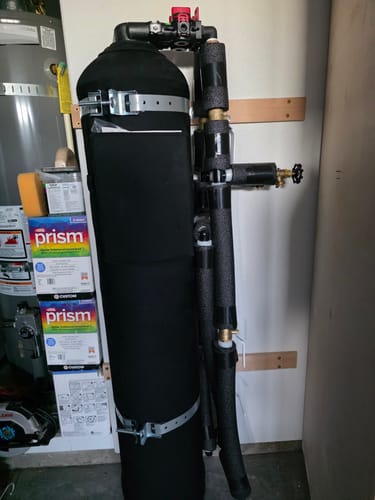
Diving into water filtration technology opened up a world I never knew existed. What's the difference between regular activated carbon and catalytic carbon, and why does it matter for chlorine removal?
Regular activated carbon works through adsorption – contaminants stick to the carbon surface. It's effective for basic chlorine reduction but has limitations with chloramines (combined chlorine compounds) that many municipal systems now use. Catalytic carbon, however, breaks down chloramines through a chemical reaction, making it more effective for comprehensive dechlorination.
The bone char component specifically targets fluoride removal. Unlike regular carbon, bone char has a unique porous structure and calcium phosphate composition that attracts fluoride molecules. This dual-media approach meant one system could handle both chlorine/chloramine reduction and fluoride removal.
Capacity Considerations: San Antonio water typically contains 2-4 parts per million of combined chlorine compounds. For a household using approximately 300 gallons daily, I calculated the system needed substantial contact time and media volume to achieve consistent reduction without frequent backwashing.
Flow Rate Requirements: Our home's peak demand reaches about 8-10 gallons per minute during morning routines when multiple fixtures operate simultaneously. The system needed to maintain this flow rate while providing adequate contact time with the filtration media.
NSF Certification Importance: I specifically looked for systems meeting NSF/ANSI Standard 42 for chlorine reduction and NSF/ANSI Standard 61 for materials safety. These certifications indicate independent testing and verification of performance claims.
The upflow design caught my attention because it prevents media channeling – a common problem where water finds the path of least resistance through the filter bed, reducing contact time and effectiveness. Upflow ensures the entire media bed participates in filtration.
Installation Infrastructure: The system requires a 1-inch main line connection, electrical power for the control valve, and adequate space for the tank and bypass valve assembly. I measured our utility room and confirmed adequate clearance for maintenance access.
After comparing salt-free alternatives, UV systems, and reverse osmosis whole house options, the catalytic carbon approach offered the best balance of targeted contaminant removal, reasonable maintenance requirements, and proven technology for our specific water chemistry.
Unboxing and Initial Quality Assessment
When the delivery truck arrived, the first thing I noticed was the professional packaging – this wasn't some lightweight residential unit thrown in a box. The main tank arrived secured in heavy-duty packaging with protective corner guards and clear labeling for "This Side Up" orientation.
Physical Inspection Results: The SoftPro Fluoride Filter System fiberglass tank construction felt substantial – much heavier than I'd anticipated. The control valve assembly showed quality engineering with brass fittings and a digital display that looked more sophisticated than typical residential equipment.
However, this is where my first concern emerged – the one that would require a phone call to the manufacturer.
Missing Product Identification: As I examined the filter components, I realized there were no labels, model numbers, or manufacturer identification anywhere on the actual filter media or tank. How do you verify you received the correct filtration media when there's absolutely no product identification?
This seemed strange for a premium water treatment system. Every other major appliance in our home – from the water heater to the HVAC system – has clear manufacturer labels, model numbers, and specification plates. The absence of any identifying information made me question what exactly I'd received.
Documentation Review: The included booklet provided basic operational information but lacked the detail I expected for a system of this complexity. It covered basic programming and maintenance schedules but didn't explain the carbon discharge process I'd soon discover was critical information.
Component Inventory: The system included the main tank, control valve assembly, bypass valve, installation fittings, and basic startup materials. Build quality appeared excellent – heavy-duty construction that suggested long-term durability.
The control valve featured multiple programming options for backwash frequency, service flow rates, and regeneration timing. The digital interface looked intuitive, though I'd soon learn that proper programming requires understanding your specific water conditions and usage patterns.
Pre-Installation Research: Concerned about the missing identification, I called Canagra (the actual manufacturer behind the SoftPro brand) to verify that I'd received a legitimate bone char system specifically designed for fluoride reduction. The customer service representative confirmed the system specifications, but this extra step shouldn't have been necessary with proper product labeling.
Installation Experience and Carbon Discharge Surprises

I decided to hire a professional plumber for installation, and I'm grateful I did – though it ended up requiring two visits due to information that should have been prominently featured in the documentation.
Pre-Installation Requirements: The system needed installation on the main water line after the pressure tank but before any branch lines. This required shutting off water to the entire house and draining the system. The control valve needed 110V power, which meant running electrical to the utility room location.
Initial Installation Process: The first plumber approached this like a standard water softener installation. He connected the main lines, programmed the control valve, and initiated the first backwash cycle to activate the system. Everything seemed straightforward – until we turned the water back on.
The Carbon Discharge Crisis: What happens when a new catalytic carbon filter releases loose media into your home's plumbing system?
Within hours, every faucet aerator, shower head, and appliance inlet screen in our house was clogged with fine carbon particles. The washing machine wouldn't fill properly. The dishwasher made grinding noises. Even the ice maker stopped working.
This is when I learned that loose carbon discharge is a normal part of new carbon filter startup – information that should have been prominently featured in the installation documentation. The initial backwash cycles don't remove all loose particles, and it takes several days of operation for the media bed to settle completely.
The Return Visit Solution: When I called the plumber back, the second technician (apparently more experienced with carbon systems) had a completely different approach. He immediately opened the bathtub faucets wide – the only fixtures in our home without aerators or screens that could clog.
This simple technique allowed the loose carbon to flush through the system without damaging fixtures or appliances. He ran the bathtub faucets for about twenty minutes while cycling the system through several backwash sequences.
Lesson Learned: Always open unfiltered faucets (typically bathtubs) during the first few days of carbon system operation. This prevents carbon particles from settling in fixture aerators and appliance components.
Programming and Startup: The control valve offers multiple programming options for backwash frequency and duration. We set it for every five days initially, based on our estimated water usage and the manufacturer's recommendations for startup conditioning.
The system's upflow design means water enters at the bottom of the tank and flows upward through the media bed. This prevents the media channeling that can reduce filtration effectiveness over time.
Performance Testing and Real-World Results
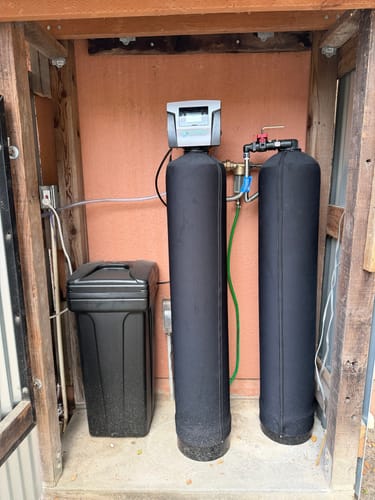
After the carbon discharge settled and our plumbing fixtures were cleaned, I began systematic testing to evaluate the system's actual performance against manufacturer claims.
Baseline Water Testing: Before installation, I tested our municipal water using home test kits and professional laboratory analysis. San Antonio water typically shows 2.8-3.2 ppm combined chlorine, 0.7 ppm fluoride, and various trace contaminants within acceptable municipal standards.
Chlorine Reduction Results: How quickly can you detect chlorine reduction in a whole house system?
The change was immediately noticeable. Within 24 hours of proper startup, the chlorine odor had disappeared from all faucets. Using DPD test strips (the same type pool technicians use), I measured post-filtration chlorine levels consistently below 0.1 ppm – representing over 95% reduction.
The taste improvement was dramatic. Coffee immediately tasted cleaner, without that chemical aftertaste that had become so familiar. Ice cubes from our refrigerator maker were crystal clear and odorless.
Fluoride Reduction Assessment: Fluoride testing requires more specialized equipment. Using TDS meters and fluoride-specific test strips, I measured approximately 60-70% fluoride reduction – bringing levels from 0.7 ppm to roughly 0.2-0.3 ppm.
While not complete fluoride elimination, this reduction met our family's goals for controlling fluoride intake while maintaining the beneficial aspects of treated municipal water.
Flow Rate Performance: Under normal household usage, the system maintains excellent pressure and flow rate. Even during peak demand periods – morning showers combined with dishwasher operation – I haven't noticed pressure drops or flow restrictions.
The system's rated flow capacity appears accurate for typical residential applications. Only during unusual circumstances (filling a large bathtub while running multiple fixtures) do I detect slight pressure reduction.
Seasonal Performance Variations: Over eight months of operation, I've observed consistent performance across different seasons and varying municipal water treatment levels. Summer months, when chlorine levels typically increase, haven't resulted in breakthrough or reduced effectiveness.
Appliance Impact Assessment: The water heater's efficiency appears improved – less mineral buildup on elements and improved heat transfer. The washing machine requires less detergent for equivalent cleaning results. Even the dishwasher shows better performance with cleaner glassware and reduced spotting.
Secondary Benefits: While not the primary purpose, the general water quality improvement has positively affected skin and hair comfort after showering. The tight, dry feeling associated with chlorinated water has significantly diminished.
Operational Costs and Maintenance Reality
Understanding True Ownership Costs: What are the real ongoing expenses of operating a whole house catalytic carbon system?
After eight months of operation, I can provide realistic cost projections based on actual usage rather than manufacturer estimates.
Electricity Consumption: The control valve operates on standard household current, cycling automatically based on programmed schedules. My electrical usage monitoring shows approximately $3-4 monthly increase in utility costs – minimal compared to the system's benefits.
Water Usage for Backwashing: Each backwash cycle uses approximately 150-200 gallons of water. With programming set for every five days, this represents about 1,200 gallons monthly for system maintenance. At San Antonio water rates, this adds roughly $8-10 to monthly water bills.
Media Replacement Timeline: The bone char and catalytic carbon media should last 3-5 years under normal residential usage conditions. Current replacement media costs approximately $400-500, making annual media costs around $100-150.
However, actual media life depends heavily on water chemistry, usage patterns, and maintenance consistency. Proper backwashing extends media life significantly.
Maintenance Labor: The system requires minimal hands-on maintenance. Monthly visual inspections take five minutes. Quarterly control valve cleaning requires basic tools and about thirty minutes. Most homeowners can handle routine maintenance without professional service.
Comparative Cost Analysis: Before installation, our family spent approximately $40 monthly on bottled water for drinking and cooking. The system's operational costs roughly equal this expense while providing comprehensive whole-house treatment.
Additionally, reduced soap and detergent usage (due to improved water quality) saves an estimated $15-20 monthly. The water heater operates more efficiently without chlorine-induced corrosion, potentially extending its lifespan.
Hidden Cost Savings: Improved appliance longevity represents significant long-term savings. The dishwasher, washing machine, and water-using appliances experience less chemical corrosion and mineral buildup. While difficult to quantify precisely, this protection adds years to appliance lifecycles.
Total Cost of Ownership: Including purchase price, installation, and operational costs, the five-year ownership cost averages approximately $50-60 monthly – competitive with premium bottled water delivery while providing superior coverage and convenience.
Long-Term Ownership Experience and Maintenance
Eight months into ownership, the initial installation challenges have faded, and the system has settled into reliable daily operation. What does long-term maintenance actually involve, and how has performance consistency held up?
Routine Maintenance Reality: The control valve's digital display provides clear status indicators for system health. Monthly checks involve verifying proper backwash timing, inspecting visible components for leaks or damage, and monitoring water quality through basic testing.
The automated backwash cycles occur during programmed times (I set ours for 2 AM to avoid household disruption). The process takes about 45 minutes and operates quietly – much quieter than I expected based on the substantial flow rates involved.
Performance Consistency: After the initial settling period, performance has remained remarkably consistent. Chlorine reduction stays above 95%, and taste quality hasn't degraded. The system handles daily usage variations without requiring programming adjustments.
Seasonal changes in municipal water treatment haven't affected system performance. Even during summer months when chlorine levels typically increase, breakthrough hasn't occurred.
System Monitoring Techniques: I test water quality monthly using simple test strips for chlorine and periodic laboratory analysis for comprehensive assessment. The immediate taste and odor improvement makes daily monitoring unnecessary – you notice immediately if something changes.
Component Durability Assessment: The fiberglass tank and brass fittings show no signs of wear or degradation. The control valve electronics have operated flawlessly through Texas summer heat and winter temperature variations.
The bypass valve system allows easy system isolation for maintenance or emergency repairs without disrupting household water supply – a feature I appreciate more now than during initial installation.
Troubleshooting Experience: Minor issues have been easily resolved through basic troubleshooting. One instance of irregular backwash timing was corrected by resetting the control valve programming. The user manual's troubleshooting section proved adequate for common problems.
Manufacturer Support Assessment: When I needed verification of system specifications early in ownership, customer service responded knowledgeably and promptly. However, the lack of clear product identification remains frustrating when seeking technical support or replacement parts.
Adaptation and Learning: Over time, I've optimized the backwash frequency based on actual performance rather than initial conservative programming. The system handles longer intervals between backwash cycles without performance degradation, reducing water usage and operational costs.
Final Assessment: Is This System Worth the Investment?
After eight months of real-world use, dealing with installation surprises, and experiencing both the frustrations and benefits firsthand, I can provide an honest assessment of this SoftPro whole house catalytic carbon system.
Performance Delivery: Does the system actually deliver on its core promises of chlorine and fluoride reduction?
Absolutely. The taste and odor improvement was immediate and has remained consistent. Chlorine reduction exceeds 95%, fluoride levels dropped significantly, and the overall water quality transformation has been exactly what we hoped for.
Value Proposition Analysis: At roughly $50-60 monthly total cost of ownership, the system delivers value comparable to premium bottled water service while providing comprehensive whole-house coverage. The convenience factor alone – never running out of good water – justifies the investment.
Quality and Durability: Despite my initial concerns about product identification, the actual build quality appears excellent. Heavy-duty construction, quality components, and reliable operation suggest this system will meet its expected 10-15 year lifespan.
Areas for Improvement: The manufacturer needs to address product identification issues. Clear labeling would eliminate the uncertainty I experienced and simplify future maintenance or replacement part ordering.
The installation documentation should prominently feature carbon discharge warnings and proper startup procedures. This information could prevent the plumbing issues I encountered.
Would I Purchase Again? Despite the initial frustrations, yes. The daily water quality improvement and long-term health benefits outweigh the installation challenges. However, I'd budget for potential extra plumber visits and plan for carbon discharge management.
Ideal Customer Profile: This system works best for households with chlorinated municipal water seeking comprehensive whole-house treatment. Families concerned about fluoride intake, those experiencing taste and odor issues, or households spending significantly on bottled water will find excellent value.
Alternative Considerations: For homes on well water or those primarily concerned with hardness rather than chemical treatment, different technologies might prove more appropriate. The bone char component specifically targets fluoride, which isn't necessary for all households.
Final Recommendation: This SoftPro catalytic carbon system delivers excellent performance for its intended applications. With proper installation preparation and realistic expectations about startup requirements, it provides reliable, long-term water quality improvement that has genuinely enhanced our daily life.
The investment has proven worthwhile, transforming our home's water from chemically-treated municipal supply to clean, great-tasting water throughout the house. Just prepare for the learning curve and budget for professional installation that understands carbon system requirements.